Grounding Activities to Reduce Anxiety Quickly
Does Anxiety Hit You At The Most Inopportune Times? Try This Quick Trick To Reduce Anxiety Quickly
Having one of those anxiety-filled days? Maybe it started with your kid waking you up too early, skipping breakfast, losing your cool more often than you'd like, and now you're heading to work, trying to keep it together. You can't call in sick, can't take a mental health day, and telling your coworkers off is not an option. So, how do you quickly regulate yourself, calm your nervous system, and prepare to face the day without losing it? The answer lies in a simple yet effective Dialectical Behavioral Therapy anxiety management technique: the Five Senses Grounding Exercise.
Five Senses Grounding Exercise
This holistic grounding exercise for anxiety doesn't require any equipment or a specific setting. You can practice it anywhere, even while sitting at a red light or stuck in traffic. Here's how it works:
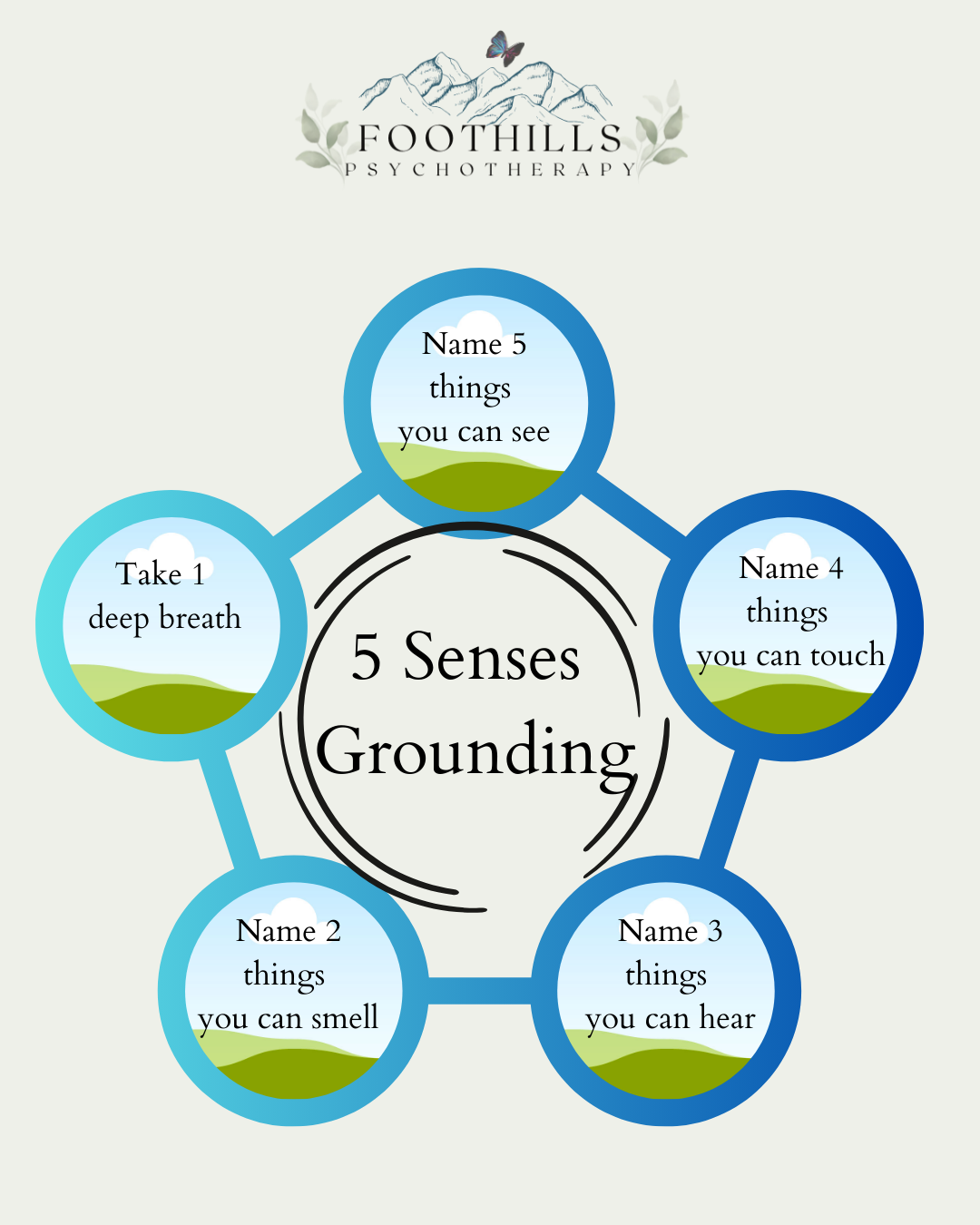
ID: Shows the five senses grounding exercise
Name 5 things you can see
Name 4 things you can touch
Name 3 things you can hear
Name 2 things you can smell
Take a deep breath or drink a sip of water
That's it! Super simple, right? Yes and no. The key is to remind yourself to do it. Once you do, you'll notice your nervous system calming down, transitioning from hyperarousal to a regulated state. By slowing down and focusing on what you can see, touch, hear, smell, and taste, you're signaling your brain that it can exit the "fight or flight" mode and return to a state of calm.
What is the science behind this Dialectical Behavior Therapy Anxiety Technique?
Our brains want to help us heal and they are also programmed to keep us safe. Our lizard brains are the oldest part of our brain and it is stuck in its ways. So it has a hard time distinguishing between a general sense of worry and an actual animal that is there to cause danger! So when that general sense of anxiety comes up, alarm bells go off. This is commonly referred to as fight or flight.
Fight or flight works fast, your brain is quickly telling you if you need to run away from the animal or turn around and fight it. Is it larger than you? Flee, is it smaller or a potential food source? Fight. But most people aren’t living in a world where they need to calculate the risk around an animal that is threatening them. And that is when your brain needs to understand that you are safe, just needing some help with that test anxiety. So when you slow down and notice the world around you, you are sending signals to your brain that you are not being immediately threatened by an animal and it can quiet down and switch to the more developed part of your brain, the neocortex.
What if that doesn’t work to reduce my stress & anxiety?
For some, the state of hyperarousal might be so intense that they need to expand on each step. In such cases, you can name and describe the things you see, touch, hear, and smell in detail. Take a deep breath, drink water, and repeat if necessary. Generally, slowing down and assuring your brain that you are safe—just feeling frustrated—enables you to regulate your emotions and move into the next part of your day feeling more calm and collected.
Incorporating the Five Senses Grounding Exercise into your routine can be a game-changer for managing anxiety. It's a simple, effective therapy technique that helps bring your focus back to the present moment, reducing anxiety symptoms and promoting a sense of peace.
Additional Anxiety Management Techniques:
Cognitive Behavioral Therapy (CBT) for Anxiety: CBT helps individuals identify and change negative thought patterns, making it an effective therapy for anxiety.
Mindfulness-Based Stress Reduction (MBSR): MBSR combines mindfulness practices with stress reduction strategies to alleviate anxiety symptoms.
Exposure Therapy: This technique involves gradually facing anxiety-provoking situations to reduce avoidance behaviors.
Dialectical Behavior Therapy (DBT): DBT combines cognitive-behavioral techniques with mindfulness to teach coping skills and emotional regulation.
Holistic Therapy Approaches: Practices like yoga, meditation, and acupuncture can complement traditional therapies to promote relaxation and well-being.
Brainspotting for Anxiety: Brainspotting is a therapeutic approach that identifies and processes trauma stored in the brain by using specific eye positions. This technique can help reduce anxiety by accessing and resolving deeply rooted emotional pain, leading to greater emotional regulation and relief from anxiety symptoms. If you are in need of a therapist, all of our therapists are trained in Brainspotting for Anxiety. Click here to have a free consult with one of our therapists.
Remember, the next time you feel anxiety creeping in, take a moment to ground yourself using your five senses. Your mental health will thank you.